

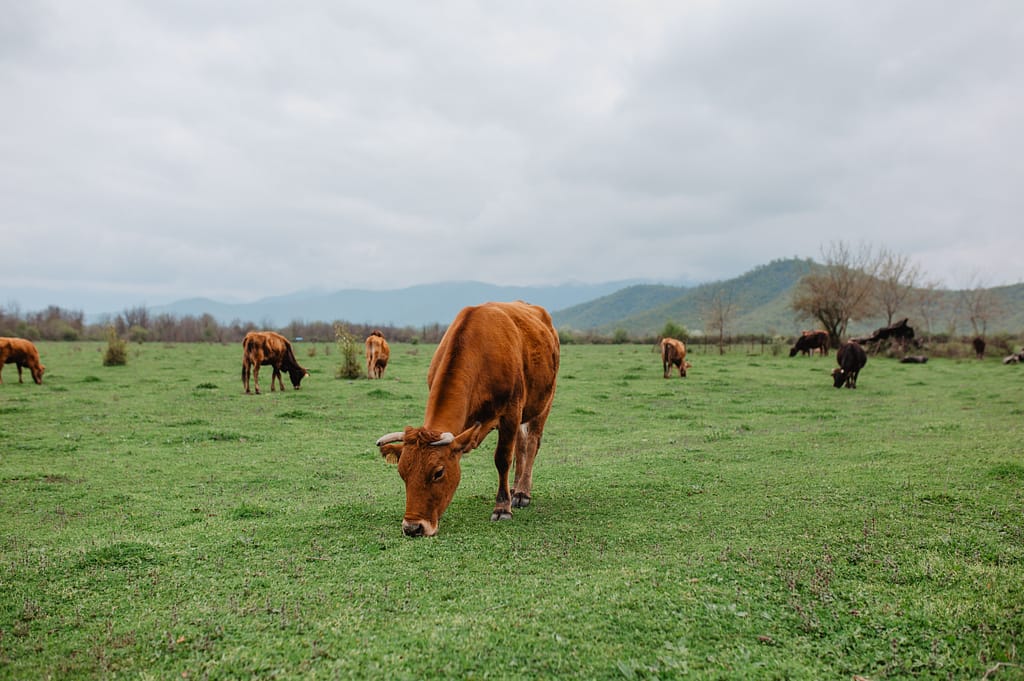
A paper in Nature suggests that, per kilo of food produced, extensive farming (like in open grasslands across vast areas) causes greater greenhouse gas emissions, soil loss, water use and nitrogen and phosphate pollution than intensive farming (like in enclosed, smaller areas).
If everyone ate pasture-fed meat, we would need several new planets on which to produce it. A much better alternative to pasture fed meat is cultured meat, which is chemically and physically identical to farmed meat.
See more in the longer post on regenerative farming.
Topic: FAQ – Environment

It is not. A lot of the Brazilian rainforest is used to grow soy. Well over 96% of soy from the Amazon region is fed to cattle, pigs and chickens around the world according to data from the UN Food and Agriculture Organization.
Livestock are fed soy because it helps them grow faster, fatter, and is cheaper than grass. If you want to protect forests that are being replaced for soy farms, you can consume less meat.
Furthermore, 97% of Brazilian soy is genetically modified, which is banned for human consumption in many countries and is rarely used to make tofu and soy milk in any case. [The Guardian]

Topic: FAQ – Environment
According to a study published in Elementa Science, it showed a vegan diet was not as beneficial to land use vs. a <40% omnivorous diet.
The same study also mentioned that “livestock production is the largest land user on Earth,” and that people need to incorporate more plant-based diets.
The reason why mainstream media interpreted this study to counter veganism is because of its assumption that grazing land can only be used for livestock. It stacked the available land against the vegan model. It did not take into account perennial cropland which could grow human-friendly grains like wheat, millet, sorghum, rye, or cereal rye which can grow in arid, low fertility soil. It is currently used to grow grains that are being to fed to livestock, but the study did not assume this land could be used to feed people. With this consideration, a vegan diet’s land use would surpass all other diets.
The study also removed all forest land from a vegan diet. This is incorrect since forest farming can grow greens, berries, mushrooms, nuts, etc.
The study assumed the vegan model crop portfolio to include less calorie dense foods per acreage, which is not a practical assumption.
The study assumed the US has very little arable cropland at 95M hectares, but the World Bank estimates US has 155M hectares.
With all these considerations, the results would look different. [MicTheVegan]

Topic: FAQ – Environment
Growing almonds is water intensive, and is just as bad as livestock farming. They also harm the bees.
The graph from UC Davis shows that the amount of water needed to grow almonds in California is so low that it was combined with all pistachio farming as well. It was still far lower than the two leading categories (alfalfa and pasture) which are specifically for livestock.
The almonds grown in California account for 82% of the world’s almond production and is still low. Whereas the water used for the livestock feed is not even close to the global supply of animal products that alfalfa/pasture will ultimately create.
Rising demand of almonds has driven rapid intensification in specific places, like California, which could be addressed with proper regulation. It has nothing to do with what almonds need to grow. Traditional almond production in Southern Europe uses no irrigation at all. It is also perhaps worth noting that the bees that die in California are not wild, but raised like livestock by farmers to help pollinate the almond trees. [The Guardian]

Topic: FAQ – Environment
Mice and other rodents also die during the harvest on veganic farms
It is true that the production and harvesting of crops does cause the death of animals like aphids, caterpillars, moths, worms, flies, locusts – and even birds, mice and rats.
The goal is to reduce harm. And about intentions. There is a difference between deliberately raising an animal to kill them vs. an accidental by-product of modern, mechanized harvesting. That’s like if a firefighter goes into a burning building and realizes he cannot save everyone so he does not try save anyone. Or the idea that if you are driving and you accidentally run over a dog vs deliberately trampling over it. [Earthling Ed]
Even so, more animals are killed due to animal agriculture because a farmed animal eats more plants throughout its lifetime and thus causes more secondary farm creatures to die. [MicTheVegan]

Topic: FAQ – Environment
Calorie by calorie, it takes more GHG to grow lettuce than the equivalent calories in bacon.
The USDA says the average American ate 71lbs of red meat a year or 3.2oz of in a day, the caloric equivalent to almost 6 heads of lettuce a day. Unless you know someone who eats this much lettuce each day, that in itself shows the absurdity of the claim.
According to a study on diets, vegan diets emitted around half the average greenhouse gasses than a meat eating diet.

Topic: FAQ – Environment
Since honey is a byproduct, I am not harming bees if I take some honey.
Most bottled honey and any honey inside a product is from honey farms where the bees are manipulated and smoked to be docile workers. The queen bee’s wings are often clipped so she cannot fly anywhere. Because they are bred in massive scales, there is also a massive dying at the end of every season which we are funding by purchasing honey. It’s similar to the idea of milk or eggs or wool – though a byproduct, it still perpetuates an unjust system.
As for wild honey, the entire honey process is gross since the nectar is stored inside a bee’s tummy and then regurgitated back into the honey combs. Honey is bee vomit.
Bees gather honey for their own families and colony, not for humans. A bee can visit up to 10,000 flowers to make 1 teaspoon of honey. That’s like me going to a very far away grocery store to buy one week worth of food and then the next morning I see it’s all suddenly gone.

See video to better understand the negative impacts of the honey industry on bees and the environment
Topic: FAQ – Animals
Some lands have such degraded soil and harsh climate that only livestock grazing is possible.
The opposite is true. Plants are more adapted to grow in harsh climate and soil than animals like cattle, buffalo, sheep, or goats.
Let’s look at Sub-Saharan Africa. It has suffered extreme droughts over the years and traditional farmers have seen more of their livestock die year after year. This is why more members of the Maasai community of Kenya, who are traditionally livestock farmers, have begun to shift towards growing crops as well. In one county, “as drought and a boom in housing development eat away at available grazing land, the number of Maasai herders taking up crop farming has grown by 40% over the past decade.” [Reuters]

Topic: FAQ – Environment