

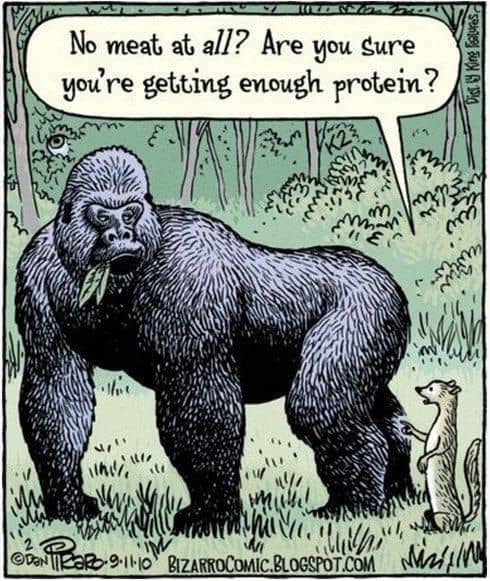
Vegans get their protein from where everyone gets their protein: from plants. All protein comes from plants.
Yes, vegans get enough protein. In fact, a lot. Please see here for more.
Topic: FAQ – Health

Just because one authority says something does not mean that it is ethically or factually correct.
Even though your doctor says so, you are welcome to look at the nutritional research and peer-reviewed studies on veganism for yourself, come to your own understanding, and present these thoughts to your doctor. Ultimately, all doctors want their patients to be healthy. If you can choose a nutritionally superior way to reach there through plants, and save the environment and animal lives at the same time, any doctor should only be happy with that.

Topic: FAQ – Health
Even though something is pleasurable, it does not mean it is morally acceptable.
It might be pleasurable to some people to abuse children, own slaves, or set things on fire, but it does not make it acceptable. [If this statement bothers you, please note comparing is note equating.]
There are so many meat substitutes in the market today, from cultured to plant-based. By replacing even a single meal with either of those choices, not only will you be allowing an animal to live, but your health and the environment will thank you too.

Topic: FAQ – Health
Evolution would not have given us big brains if we didn’t eat meat.
Humans did not evolve to eat meat. Carnivores have fangs and claws. Humans have nails and our teeth are flat so we can grind starches. Carnivore mouths go up-down, our mouths also go sideways so we can grind. The canine on our teeth are too blunt to eat flesh but do help us eat apples.
The largest land mammals are herbivorous: elephant, gorilla, hippopotamus. All these creatures have the biggest canine teeth on land but don’t eat meat.
Our intestines are long (15x body length) to be able to digest plant fiber and nutrients. The intestines of carnivores are short (4x body length) with a lot of strong acids so they can quickly digest raw meats and pass it out of their system.
Humans have trichromatic vision to see more colors like ripe fruits vs carnivores with dichromatic vision.
The brain runs mostly on glycogen which is from plants, not meat.
Carnivores want to eat raw meat and are not picky about what parts they eat. Humans will die if they eat most raw meat or milk, and get grossed out if it’s a part they’re not used to, like brains.
We do not instinctually crave killing an animal or its flesh. If you are locked in a room with an apple and a chicken, you will want to eat the apple.

Topic: FAQ – Health
Yes, you need B12 supplements on a vegan diet.
Everyone over the age of 50 is recommended to take a B12 supplement regardless of their diet. 40% of the population in general takes a supplement anyway.
Only bacteria creates Vitamin B12. Animals do not. People eat animals and consume it indirectly, and even then you are most likely eating a supplement because 90% of the world’s B12 supplements are given to animals. Getting B12 indirectly also means that someone who takes a B12 supplement directly is more likely to have higher levels in body than a meat eater. [Baltimore Post Examiner]
2-4% of Americans are deficient on B12 anyway. [American Journal of Clinical Nutrition]
Untreated water (from ponds, river,) and soil have enough B12, which explains why early humans were not B12 deficient even if they did not eat animals. [Bulleting of the Torrey Botanical Club] New research finds that there are some plants, like duckweed, that contain B12 as well and could be a clue to our evolution; see video for more.
A truly healthy gut can prepare its own B12 from the bacteria it produces. Two strains of bacteria in the small intestines can be created and absorbed, but it is not worth the risk vs the safety to supplement. [Nature]

Topic: FAQ – Health
Like with anything you’re new to, start slowly and build your way up.
Eating a legume rich diet might give about 3% of the population more gas for about two days. Then you can reap a lifetime of benefits in all your daily activities and a potentially longer life. Just like in this study from the Asian Pacific Journal of Clinical Nutrition, legumes were the one food most associated with survival in elderly populations around the world. [Journal of Nutrition]

Topic: FAQ – Health
Organic meat, dairy, eggs from free range, grass fed, small local farms is not as bad as factory farms
Organic cow’s milk has more estrogen than conventional milk. An egg from a battery hen or a pasture raised hen equally have around 200mg cholesterol. Red meat is still classified as a Group 1 carcinogen (in the same category as tobacco or asbestos) by the WHO. Organic meat also uses more land per animal than conventional meat with longer animal lifespans, exacerbating their environmental impact.
If nutrition is your goal, iceberg lettuce has more antioxidants than salmon or eggs combined. [The Game Changers]

Topic: FAQ – Health
We have been eating meat and drinking milk for generations. If my ancestors did it, it’s good enough for me.
Traditions are so important. The thing that makes a tradition valuable is the love of the people. You can modify the ingredients and still keep the tradition.
The Yulin and Boknal Dog Meat Festival, bullfighting, rodeos, circus are all traditions that still go on.
There are many things that were traditional that we no longer think so. Slavery, women’s right to vote, gender equality, etc. Our values evolve.

Topic: FAQ – Health
Soy has compounds similar to estrogen, called phytoestrogen. These are much weaker than mammalian estrogen.
Phytoestrogen consumption actually has a good effect on your body. Since they have a similar shape they can sit in your cell’s estrogen receptors and block the mammalian estrogen from getting in, an anti-estrogenic effect. This leads to lower breast cancer, prostate cancer, cancer related death rates, 13% decrease in LDL, lower heart and kidney disease. [American Journal of Health Education, American Heart Association, Journal of Renal Nutrition, The New England Journal of Medicine]
In a study where men drank 400ml soy milk everyday, their testosterone stayed the same and their estrogen actually decreased by 3% [American Association for Cancer Research]
Study on 36 groups of men who had concentrated soy, like tofu, still did not have their reproductive hormones changes. [American Society for Reproductive Medicine] Meta-analysis on 47 studies showed no change in estrogen due to soy [Human Reproduction Update]
Women who had more soy protein in adolescence and early adulthood had 59% less pre-menopausal breast cancer. [American Journal of Clinical Nutrition].
Even after 2 years of women consuming soy, their hormones did not change. [American Association for Cancer Research]
Dairy milk raises blood levels of estrogen in both sexes. A 25% spike in estrogen after drinking milk, and an 18% reduction in testosterone. [AACR]
Vegan men have higher levels of testosterone, which leads to larger reproductive organs.
Listen to Dr. Neal Barnard’s views on soy
Topic: FAQ – Health
The calcium in milk is needed for strong skeletal system
Humans did not eat dairy until about 10,000 years ago. Homo sapiens have been around for 100,000 to 200,000 years. Human bones started to become more fragile after farming.
If not better, vegans do not have weaker bones than omnivores. Study on elderly Buddhist nuns found that the vegan nuns had the same bone density as the omnivore nuns.
The galactose in milk might explain why drinking more milk is associated with higher fractures. See video for more.

Topic: FAQ – Health
If oysters, mollusks, slugs, or starfish don’t have a brain or central nervous system, it should be ok to eat them.
In the taxonomic rank, these creatures fall under the Kingdom of Animalia, and hence, are animals. As are fishes, snails, monkeys, and even humans.
Although bivalves, like oysters, do not have a central nervous system or a brain, they do have nerve clusters. This allows them to react with their environment in observable and complex ways, like digging, running away, hiding, eating, etc.
Ounce per ounce, oysters have as much cholesterol as beef tenderloin steak.
ALS/Lou Gehrig Disease affects 30k people in USA. The missing link to its cause could be BMAA, a neurotoxin created by cyanobacteria which are found in ecosystems worldwide. Cyanobacteria are approx. 50% of the phytoplankton community of the open ocean covering over half of earth. As marine animals eat phytoplankton, BMAA keeps accumulating in the food chain, from small fish to bigger fish, ultimately inside humans who eat seafood. Although not confirmed nor the only cause, the link is strong. See video for more.

Topic: FAQ – Health
DHA is a long chain omega-3 fatty acid that your body can convert from ALA, which is a plant based source. When you get it from fish, it is really coming from the algae that the fish eat. Most omnivores do not eat fish everyday and miss out on that front. Instead of reprocessing something, you can get your nutrient directly from the source. [International Journal of Vitamin and Nutrition Research, Nutrition Facts]
Your body can convert a limited amount of ALA to DHA. On average, your body can extract about 3.8%. As long as you eat enough ALA, you should be fine. For ex. 1.5 serving of chia seeds has all the daily ALA for your body to convert to DHA. Flax seeds, walnuts are other good sources. Many plant based milks also come fortified with DHA. [The Vegan RD]
If you’re considering to get this from seafood, please know fishes contain the most amount of toxic industrial pollutants than any other food chain [Dr. Michael Greger]

Topic: FAQ – Health
Some people think plant based sources of iron are not as absorbable as animal based heme iron. In fact, heme iron increases risk of colorectal cancer. [American Association for Cancer Research]
Eating some Vitamin C with your plant based sources of iron increases the bio-availability of the plant based iron by more than three times, far exceeding the bio-availability of animal based heme iron. [Annual Review of Nutrition]
For ex. 1 cup of black beans is 50% of your daily iron requirement, and 1 cup of spinach is 80% of your daily iron requirement.

Topic: FAQ – Health
Without seafood, people would go hungry.
Seafood is critical for coastal communities that depend on it and have few other sources of caloric intake. Most of the world that consumes seafood is not in a situation where they have limited food options, and they can choose plant based options. Large scale trawling fishing operations (that feed seafood to most of the world) actually destroy the coastal sea life and further hurt the coastal communities that need this seafood.
Seafood is heavily subsidized. About $35 billion globally. For every $5 of seafood that is exported, $1 is subsidized. The UN says it would take $33 billion to end world hunger. Moving subsidies away from large fishing corporations could do a lot to help end hunger.

Topic: FAQ – Health
The Inuit (in Greenland, Canada, Alaska) eat meat-only diets and they are healthy.
The Inuit communities were not healthy. Inuit mummies had high rates of atherosclerosis at 60%, and osteoporosis. This was before they had any Western influence.
Inuit life expectancy was very low at 43.5 years compared to neighboring countries.
Inuit did eat plants: berries, seaweed, and a variety of other plants.
For more on a meat-only diet, see this fun video.

Topic: FAQ – Health
Keto diets require a high meat, low-carb diet, and I’ve seen good results from it.
A meta-analysis (study of several different studies) of observational studies that included 270,000+ people found that a low carbohydrate diet significantly increased chances of all-cause mortality (early death).
You might say that you know people who have gone on low carb diets and did not see a rise in their cholesterol levels. How is that possible? Because according to Dr. Michael Greger, weight loss by any means can result in a drop in cholesterol. We could go on an all-Twinkie diet and still lower our cholesterol as long as we didn’t eat too many. See more on the long-term consequences of a low-carb diet here.
Keto diets are not new. They have been used for many years to help control seizures in people with epilepsy who have certain drug resistance, but to most other people, their risk to reward ratio is poor. Keto diets with low carb and high meat increase a host of risk factors, like heart disease and diabetes. This is especially true for people with kidney issues and pregnant women.

Topic: FAQ – Health